ประสิทธิภาพของถ่านชีวภาพต่อการปรับปรุงคุณสมบัติดินและการเจริญเติบโต ของต้นฟ้าทะลายโจรในพื้นที่จังหวัดนครนายก
Effectiveness of biochar application on soil properties and growth performance of Andrographis paniculata in Nakhon Nayok Province
Keywords:
Soil amendment, Biochar, Soil properties, Andrographis paniculata (Burm.f.) Wall ex Nees , Degraded soilAbstract
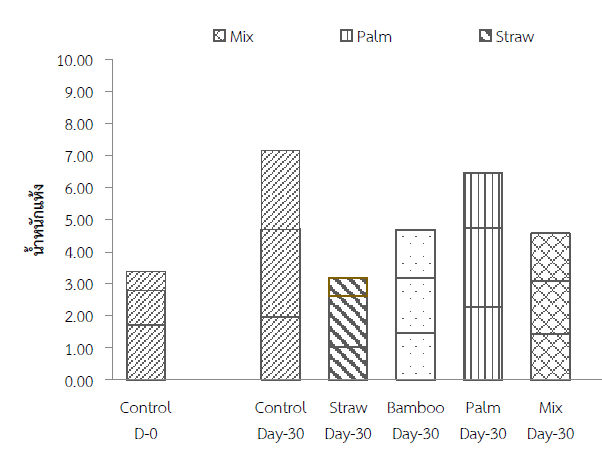
ปัญหาคุณสมบัติดินส่งผลกระทบต่อการเจริญเติบโตและผลผลิตพืชในหลายพื้นที่ โดยพบมากในเขตเกษตรกรรมบริเวณที่ราบลุ่มแม่น้้าซึ่งเคยมีการทับถมของตะกอนน้้ากร่อย ท้าให้ดินมีข้อจ้ากัดต่อการเจริญเติบโตของพืช ขณะเดียวกัน ในช่วง การแพร่ระบาดของโรคโควิด-19 ฟ้าทะลายโจรถูกน้ามาใช้เป็นยาสมุนไพรอย่างแพร่หลายเพื่อบรรเทาอาการป่วย จึงได้มีการคาดการณ์ว่าในอนาคตอาจมีการน้ามาใช้เพิ่มสูงขึ้น งานวิจัยนี้มุ่งศึกษาผลของการปรับปรุงดินด้วยถ่านชีวภาพที่ผลิตจากวัสดุเหลือทิ้งทางการเกษตร 5 ชนิด ได้แก่ ทะลายปาล์ม ล้าต้นไผ่ ฟางข้าว และเหง้ามันส้าปะหลังผสมกับซังข้าวโพด ในพื้นที่จังหวัดนครนายก เพื่อประเมินประสิทธิภาพการยกระดับคุณภาพดินควบคู่กับการผลิตพืชสมุนไพรที่เป็นมิตรต่อสิ่งแวดล้อม โดยศึกษาคุณสมบัติดิน ได้แก่ ค่า pH ปริมาณอินทรียวัตถุ คาร์บอนและไนโตรเจนทั้งหมดในดิน รวมถึงการเจริญเติบโตและน้้าหนักแห้ง ของฟ้าทะลายโจร ผลการทดลองพบว่า ถ่านชีวภาพจากเศษซากพืชทั้ง 4 สูตร สามารถช่วยปรับปรุงคุณภาพดินอย่างมีนัยส้าคัญทางสถิติ ประกอบด้วย ช่วยเพิ่มค่า pH ปริมาณคาร์บอน อินทรียวัตถุ และไนโตรเจนในดิน โดยถ่านชีวภาพจากล้าต้นไผ่สามารถปรับ pH ดินเพิ่มสูงสุด มีค่าเท่ากับ 7.28 เหมาะสมต่อการดูดซึมธาตุอาหารของพืช ขณะที่ถ่านชีวภาพจากฟางข้าวให้ผลดีในด้านการปรับปรุงปริมาณคาร์บอน อินทรียวัตถุ และไนโตรเจน ในดิน มีค่าเท่ากับ 8.20%, 14.14% และ 0.245% ตามล้าดับ ด้านการเจริญเติบโตของฟ้าทะลายโจรพบว่ามวลชีวภาพสดสูงสุดในช่วง 30 วันแรก ก่อนลดลงในช่วง 60 วัน ขณะที่น้้าหนักแห้งเพิ่มขึ้นต่อเนื่องตามอายุพืช และเมื่อสิ้นสุดการทดลอง โดยน้้าหนักแห้งรวมและความสูงไม่แตกต่างจากชุดควบคุมอย่างมีนัยส้าคัญ สรุปได้ว่าถ่านชีวภาพมีศักยภาพในการยกระดับความอุดมสมบูรณ์ของดินและการกักเก็บคาร์บอน โดยเฉพาะถ่านชีวภาพจากฟางข้าวเหมาะต่อการปรับปรุงดินอย่างยั่งยืน
Soil properties significantly affect crop growth and yield in many areas, particularly in agricultural lowlands along rivers where brackish water sediment deposition limits plant growth. During the COVID-19 pandemic, Andrographis paniculata (Burm.f.) Wall ex Nees. was widely used as a herbal medicine to alleviate symptoms, leading to predictions of increased future demand. This study aimed to investigate the effects of soil improvement using biochar produced from five types of agricultural residues: palm stalks, bamboo stalks, rice straw, cassava rhizomes, and corn cobs, in Nakhon Nayok Province. The effectiveness of biochar in improving soil quality while promoting environmentally friendly herbal crop production was evaluated. Soil properties, including pH, organic matter content, total carbon, and total nitrogen, were analyzed, along with the growth and dry weight of Andrographis paniculata. The results showed that biochar derived from all five plant residues significantly improved soil quality by increasing pH, carbon, organic matter, and nitrogen contents. Bamboo biochar significantly increased soil pH to 7.28, which is optimal for nutrient availability. Rice straw biochar showed strong performance in enhancing soil carbon, organic matter, and nitrogen contents, with values of 8.20%, 14.14%, and 0.245%, respectively. Regarding plant growth, fresh biomass of Andrographis paniculata peaked at 30 days and declined at 60 days, whereas dry weight increased continuously with plant age. At the end of the experiment, total dry weight and plant height did not differ significantly from the control treatment. In conclusion, biochar has strong potential to improve soil fertility and enhance carbon sequestration, with rice straw biochar being particularly suitable for sustainable soil improvement.