การรับรู้และทัศนคติต่อความมั่นคงทางอาหารในพื้นที่เมือง กรณีศึกษา กรุงเทพมหานคร
Perceptions and attitudes toward food security in urban areas:A case study of Bangkok
Keywords:
Food security , Perception , Attitude , BangkokAbstract
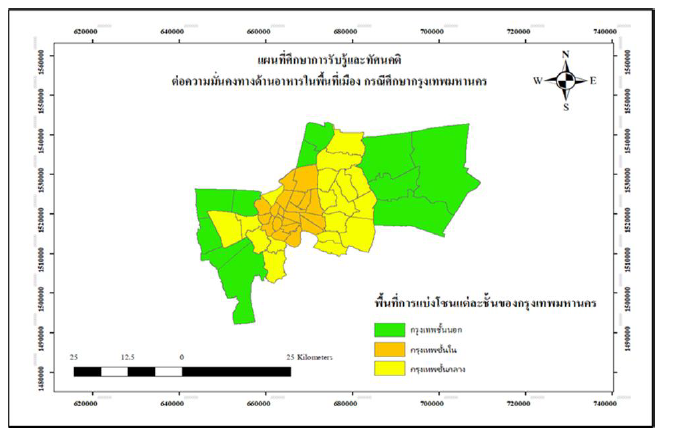
การเปลี่ยนแปลงสภาพภูมิอากาศส่งผลต่อการลดลงของปริมาณผลผลิตในภาคเกษตรกรรมนำไปสู่ปัญหาความมั่นคงทางอาหารในพื้นที่เมือง โดยเฉพาะกรุงเทพมหานครที่มีประชากรอาศัยอยู่กันอย่างหนาแน่น งานวิจัยนี้มีวัตถุประสงค์เพื่อเปรียบเทียบการรับรู้และทัศนคติต่อความมั่นคงทางอาหารในกรุงเทพมหานคร เครื่องมือที่ใช้ในการวิจัย ได้แก่ แบบสอบถาม โดยตรวจสอบความเชื่อมั่นด้วย Reliability Test (Cronbach Alpha = 0.95) หลังจากนั้นทำการแจกแบบสอบถามกับกลุ่มตัวอย่างจำนวน 100 ราย โดยวิธีการสุ่มแบบโควต้า ภายในพื้นที่เขตชั้นใน เขตชั้นกลาง และเขตชั้นนอกของจังหวัดกรุงเทพมหานคร และนำมาวิเคราะห์ด้วย Kruskal Wallis H-test เพื่อเปรียบเทียบค่าเฉลี่ยอันดับ (Mean Rank) ระหว่างกลุ่มตัวอย่าง ผลการวิจัย พบว่า การรับรู้ต่อความมั่นคงทางอาหารระหว่างเขตที่พักอาศัยหรือที่ทำงานในกรุงเทพมหานคร มีความแตกต่างกันอย่างมีนัยสำคัญทางสถิติ (p < 0.05) โดย เขตชั้นนอก มีการรับรู้ต่อความมั่นคงทางอาหารน้อยที่สุด นอกจากนี้ ทัศนคติต่อความมั่นคงทางอาหารระหว่างเขตที่พักอาศัยหรือที่ทำงานในกรุงเทพมหานคร มีความแตกต่างกันอย่างมีนัยสำคัญทางสถิติ (p < 0.05) โดยเขตชั้นนอกมีทัศนคติต่อความมั่นคงทางอาหารน้อยที่สุด ผลการวิจัยนี้ได้สะท้อนให้เห็นว่า หน่วยงานที่เกี่ยวข้องควรผลักดันนโยบายเพื่อส่งเสริมแนวทางการจัดการปัญหาความมั่นคงทางอาหารทั้ง 4 ด้านในบริบทเชิงพื้นที่ จากมุมมองการรับรู้และทัศนคติของประชาชนในกรุงเทพมหานคร งานวิจัยนี้จะสามารถนำไปประยุกต์ใช้เป็นแนวทางการพัฒนาความมั่นคงทางอาหารให้เหมาะสมกับบริบทเชิงพื้นที่ในกรุงเทพมหานครได้ในอนาคต
Climate change has led to a decline in agricultural yields, resulting in food security in urban areas, particularly in densely populated Bangkok. This research aims to compare perceptions and attitudes toward food security in Bangkok. The research instrument was a questionnaire, and its reliability was tested using the Cronbach's Alpha Test (α = 0.95). The questionnaires were distributed to 100 respondents using quota sampling within the inner, middle, and outer districts of Bangkok. Data was analyzed using the Mann Whitney U-Test and Kruskal Wallis H-test to compare mean rank among different groups. The results show a statistically significant difference (p < .05) in perceptions of food security between residential and work areas in Bangkok, with outer districts showing the lowest perception. Furthermore, attitudes toward food security also differed significantly (p < .05), with outer districts showing the lowest attitude. These findings suggest that relevant agencies should promote policies to address all four aspects of food security within their respective spatial contexts. From the perspective of public perceptions and attitudes in Bangkok, this research can be applied as a guideline for developing food security appropriate to the spatial context of Bangkok in the future.