นวัตกรรมโฟมยางพาราเสริมจุลินทรีย์ Bacillus subtilis บำบัดน้ำเสียในโรงงานอุตสาหกรรม
Innovative natural rubber foam embedded with Bacillus subtilis for industrial wastewater treatment
Keywords:
น้ำเสียอุตสาหกรรม, Bacillus subtilis, Natural rubber foam, Bioremediation, Water treatment, การบำบัดทางชีวภาพAbstract
ปัญหามลพิษทางน้ำจากการปล่อยน้ำเสียของโรงงานอุตสาหกรรมส่งผลกระทบอย่างรุนแรงต่อสิ่งแวดล้อมและสุขภาพ การศึกษานี้มีวัตถุประสงค์เพื่อ 1) พัฒนาสูตรโฟมยางพาราเสริมจุลินทรีย์ Bacillus subtilis ที่เหมาะสม และ 2) เปรียบเทียบประสิทธิภาพในการบำบัดน้ำเสียระหว่างโฟมยางพาราเสริมจุลินทรีย์ B. subtilis และโฟมยางพาราปกติ
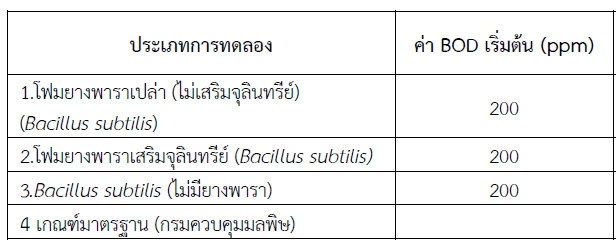
ผลการศึกษาพบว่า ประสิทธิภาพการบำบัดน้ำเสียเพิ่มขึ้นเมื่อความหนาแน่นของโฟมยางพาราลดลง โดยโฟมยางพาราเสริมจุลินทรีย์ B. subtilis ที่มีความหนาแน่นในช่วง 0.16–0.17 g/cm3 มีประสิทธิภาพสูงที่สุด ซึ่งสามารถลดค่า BOD ได้ร้อยละ 75 และลดค่า COD ได้ร้อยละ 70 ในขณะที่โฟมยางพาราปกติสามารถลดค่า BOD ได้ร้อยละ 60 และลดค่า COD ได้ร้อยละ 50 เมื่อวิเคราะห์ข้อมูลทางสถิติพบว่า โฟมยางพาราเสริมจุลินทรีย์ B. subtilis มีประสิทธิภาพในการบำบัดน้ำเสียสูงกว่าโฟมยางพาราปกติอย่างมีนัยสำคัญทางสถิติ (p < 0.05) แสดงให้เห็นว่านวัตกรรมโฟมยางพาราเสริมจุลินทรีย์ B. subtilis เป็นแนวทางที่มีประสิทธิภาพในการปรับปรุงคุณภาพน้ำเสียอุตสาหกรรมให้เป็นไปตามมาตรฐานสิ่งแวดล้อม
Wastewater treatment in the industrial sector has become a significant and escalating pollution challenge in the present day. The discharge of effluent from various industrial production processes contains diverse contaminants, including organic matter, acids, bases, and various chemicals. These pollutants lead to the degradation of receiving water bodies, which significantly impacts both the environment and public health in both direct and indirect ways.
The objective of this study was to develop a natural rubber foam reinforced with Bacillus subtilis for industrial wastewater treatment. This microorganism possesses specialized properties that assist in degrading organic matter, reducing toxicity, and restoring wastewater to a normal state before it is discharged into natural water resources. This research focused on developing an optimal formulation for natural rubber foam integrated with Bacillus subtilis and comparing its treatment efficiency against conventional foam. The findings revealed that the BOD removal efficiency increased as the density of the rubber foam decreased. Specifically, the removal efficiency for industrial wastewater using the microbial-reinforced foam reached 75% for BOD and 70% for COD, whereas the standard rubber foam achieved only 60% BOD removal. Statistical analysis confirmed that the Bacillus subtilis-reinforced foam performed significantly better than the standard foam (p < 0.05). It was further determined that foam with a density ranging from 0.16 to 0.17 grams per cubic centimeter (g/cm3) provided the highest treatment efficacy for industrial wastewater.
In conclusion, this research demonstrates the superior effectiveness of Bacillus subtilis-reinforced natural rubber foam in treating industrial effluent and successfully establishes the most suitable formulation for practical application