ผลของการแกรนูลเลชันต่อกระบวนการกำจัดธาตุอาหารทางชีวภาพ: สมรรถนะของกระบวนการและชุมชนจุลินทรีย์
Influence of sludge granulation on biological nutrient removal: process performance and microbial community
Keywords:
granular sludge , Nutrient removal , granule formation , ตะกอนชีวภาพแบบแกรนูลAbstract
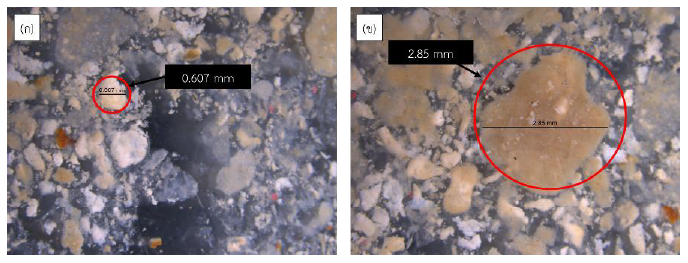
ระบบตะกอนชีวภาพแบบแกรนูล (Granular Sludge; GS) เป็นเทคโนโลยีที่มีศักยภาพในการกำจัดสารอาหาร โดยระบบกำจัดฟอสฟอรัสทางชีวภาพแบบแกรนูล (Enhanced Biological Phosphorus Removal with Granular Sludge; EBPR-GS) ขึ้นอยู่กับสภาวะการเลี้ยงตะกอนและการเดินระบบ งานวิจัยนี้มีวัตถุประสงค์เพื่อประเมินสมรรถนะของระบบ EBPR-GS ระหว่างระยะก่อนการก่อตัวของตะกอนแกรนูล (R1) และระยะหลังการก่อตัวของตะกอนแกรนูลที่เสถียร (R2) การทดลองดำเนินการในถังปฏิกรณ์แบบลำดับ (SBR) โดยลดรอบการทำงานจาก 12 ชั่วโมงเป็น 6 ชั่วโมง และลดระยะเวลาการตกตะกอนจาก 1 ชั่วโมงเหลือ 0.5 ชั่วโมง ส่งผลให้ภาระบรรทุกต่อหน่วยปริมาตรเพิ่มขึ้น ผลการทดลองพบว่าในระยะ R2 ประสิทธิภาพการกำจัด COD เพิ่มขึ้นจาก 85.5±4.2% เป็น 90.44±2.65% ขณะที่การกำจัดไนโตรเจนรวมลดลงจาก 69.81±7.43% เป็น 51.50±7.01% การกำจัดฟอสฟอรัสมีค่าใกล้เคียงกัน (64.56± 5.17–55.85± 6.04%) คุณสมบัติการตกตะกอนของชีวมวลดีขึ้นอย่างชัดเจน โดยค่า SVI5 ลดลงจาก 147 เป็น 30 mL/g และค่า SVI5/SVI30 เพิ่มขึ้นจาก 0.67 เป็น 0.98 ผลดังกล่าวสะท้อนให้เห็นว่าการลดระยะเวลาการตกตะกอนมีบทบาทสำคัญต่อการคัดเลือกชีวมวลที่มีความหนาแน่นสูงและเสถียร ส่งเสริมการพัฒนาโครงสร้างแกรนูลในระบบ R2 การวิเคราะห์ชุมชนจุลินทรีย์พบว่า Candidatus Competibacter (GAO) ลดลง (15.25%) และไม่ปรากฏในระยะ R2 ขณะที่กลุ่มที่เกี่ยวข้องกับการสร้าง EPS และโครงสร้างแกรนูล เช่น Comamonadaceae (6.20%), Pseudomonas (3.76%) และ Amaricoccus (4.83%) เพิ่มขึ้นรวมถึงการคงอยู่ของThauera และBurkholderiales ซึ่งเป็นกลุ่ม denitrifying phosphorus-accumulating organisms (DPAO) งานวิจัยนี้แสดงให้เห็นว่า R2ช่วยเพิ่มความเสถียรของระบบและเหมาะในระบบบำบัดน้ำเสียที่มีข้อจำกัดด้านพื้นที่และต้องการรองรับภาระบรรทุกสารอาหารที่ผันผวนในระยะยาว
Granular sludge (GS) is a promising technology for nutrient removal, in which the performance of enhanced biological phosphorus removal with granular sludge (EBPR-GS) strongly depends on sludge cultivation conditions and operational strategies. This study aimed to evaluate the performance of an EBPR-GS system during the pre-granulation stage (GS-1) and the stable granulation stage (GS-2). The experiments were conducted in a sequencing batch reactor (SBR) by reducing the cycle time from 12 h to 6 h and shortening the settling time from 1 h to 0.5 h, thereby increasing the volumetric organic and nutrient loading rates. The results showed that in GS-2, COD removal efficiency increased from 83 ± 4.3% to 95.32 ± 3.2%, while total nitrogen removal improved from 51.9 ± 7.8% to 55.9 ± 8.3%. Phosphorus removal efficiencies remained comparable (58.9 ± 6.1–59.2 ± 5.5%). The settleability of the biomass improved markedly, with SVI5 decreasing from 147 to 30 mL/g and the SVI5/SVI30 ratio increasing from 0.67 to 0.98. These results indicate that shortening the settling time plays a key role in selecting dense and stable biomass, thereby promoting granule formation in the EBPR-GS system. Microbial community analysis revealed a decrease in Candidatus Competibacter (GAO) (15.25%) and its absence in GS-2, whereas microorganisms associated with extracellular polymeric substances (EPS) production and granule structure, including Comamonadaceae (6.20%), Pseudomonas (3.76%), and Amaricoccus (4.83%), became more prominent. In addition, the persistence of Thauera and members of Burkholderiales, which are considered denitrifying phosphorus-accumulating organisms (DPAOs), highlights the potential of granular structures to support stable nutrient removal. Overall, this study demonstrates that EBPR-GS enhances system stability and is suitable for wastewater treatment systems with limited space and fluctuating nutrient loadings.