การวิเคราะห์เชิงพื้นที่ของแนวโน้มความเค็มในน้้าบาดาล พื้นที่อ้าเภอเชียงยืน จังหวัดมหาสารคาม
Spatial analysis of groundwater salinity trends Chiang Yuen District, Maha Sarakham Province, Thailand
Keywords:
Groundwater Salinity , Total Dissolved Solids, ความเค็มในน้้าบาดาล, ชั้นเกลือหินAbstract
การศึกษานี้มีวัตถุประสงค์เพื่อวิเคราะห์แนวโน้มค่าความเค็มของน้้าบาดาลในพื้นที่อ้าเภอเชียงยืน จังหวัดมหาสารคาม ซึ่งเป็นพื้นที่ใช้น้้าบาดาลเป็นแหล่งน้้าหลัก และประสบปัญหาคุณภาพน้้าบาดาลอย่างต่อเนื่อง เนื่องมาจากสภาพทางอุทกธรณีวิทยาที่รองรับด้วยชั้นหินให้น้้าภูทอกต่อเนื่องกับชั้นหินให้น้้ามหาสารคาม ซึ่งมีชั้นเกลือหิน (NaCl) แทรกสลับอยู่ในบริเวณใกล้เคียงกัน ปัจจุบันพบว่าคุณภาพน้้าบาดาลในพื้นที่มีแนวโน้มค่าสารละลายในน้้าทั้งหมด (Total Dissolved Solids: TDS) เพิ่มสูงขึ้น
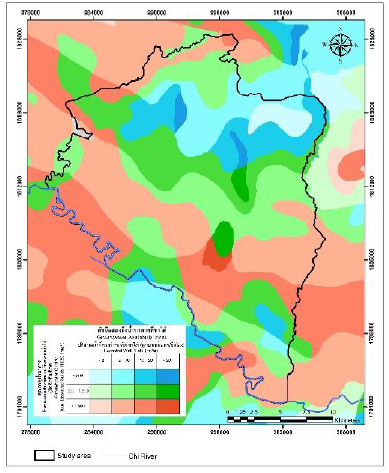
การวิเคราะห์มุ่งเน้นการศึกษาข้อมูลคุณภาพน้้าบาดาล โดยวิเคราะห์ค่า TDS ซึ่งพบว่ามีความสัมพันธ์อย่างมีนัยส้าคัญกับค่าคลอไรด์ (Cl) ที่สะท้อนอิทธิพลของชั้นเกลือหินในพื้นที่ศึกษา การศึกษานี้ใช้วิธีการทางสถิติระบบสารสนเทศภูมิศาสตร์จัดการ วิเคราะห์ และแสดงผลข้อมูลเชิงพื้นที่ ในรูปแบบแผนที่การกระจายตัวของความเค็มในน้้าบาดาล ร่วมกับการจัดท้าแผนภูมิไปเปอร์ (Piper Diagram) เพื่อจ้าแนกชนิดของน้้าบาดาล ผลการศึกษาพบว่า การกระจายตัวของความเค็มในน้้าบาดาลมีแนวโน้มกระจายตัวเป็นบริเวณกว้างมากขึ้น โดยเฉพาะในพื้นที่ลุ่มต่้าที่มีการสูบใช้น้้าบาดาลอย่างหนาแน่น และมีชั้นเกลือหินแทรกตัวอยู่ในระดับตื้น ความสัมพันธ์เชิงพื้นที่และช่วงฤดูกาลแสดงให้เห็นถึงการรุกล้้าของน้้าบาดาลเค็มที่ถูกกระตุ้นจากการสูบน้้าบาดาลขึ้นมาใช้เกินสมดุล ผลการวิจัยน้าไปสู่การวิเคราะห์แนวโน้มการกระจายตัวของความเค็มในน้้าบาดาล เพื่อเน้นย้้าถึงความส้าคัญของการติดตามตรวจสอบอย่างต่อเนื่อง และเป็นฐานข้อมูลเชิงพื้นที่ส้าหรับก้าหนดนโยบายการบริหารจัดการ น้้าบาดาลอย่างเร่งด่วน เพื่อรักษาความยั่งยืนของแหล่งทรัพยากรน้้าบาดาลในระยะยาว
This study aims to analyze trends in groundwater salinity in Chiang Yuen District, Maha Sarakham Province, where groundwater is the primary source of water supply and persistent groundwater quality problems. The hydrogeological setting of the study area consists of the Phu Thok aquifer system overlying the Maha Sarakham aquifer, within which rock salt (NaCl) layers are interbedded in close proximity. At present, groundwater quality in the study area shows an increasing trend in total dissolved solids (TDS).
The analysis focuses on groundwater quality data, particularly total dissolved solids (TDS), which show a statistically significant correlation with chloride (Cl-) concentrations, reflecting the influence of rock salt layers within the study area. Statistical methods were applied in conjunction with Piper diagrams and ion balance analysis. The findings show an expansion of saline groundwater, especially in low-lying zones characterized by intensive groundwater abstraction and the presence of shallow rock salt layers. The observed spatial and seasonal relationships highlight the progression of saline groundwater intrusion induced by groundwater overexploitation. The findings provide a basis for evaluating trends in saline groundwater distribution, emphasizing the importance of continuous monitoring and serving as a spatial database for the urgent development of groundwater management policies to ensure the long-term sustainability of groundwater resources.
Keywords: Groundwater Salinity / Total Dissolved Solids/ rock salt layers/ chloride/ Phu Thok aquifer