การวิเคราะห์โครงสร้างโปรตีนในพิษแมงกะพรุนกล่อง โดยใช้ฐานข้อมูลชีวสารสนเทศเพื่อการออกแบบยาต้านพิษในอนาคต
Analysing the protein structure of Chironex fleckeri venom using bioinformatics databases for the future anti-venom design
Keywords:
Chironex Fleckeri , Toxin proteins , Bioinformatics, Molecular Docking , Binding affinity, แมงกะพรุนกล่อง, โปรตีนพิษAbstract
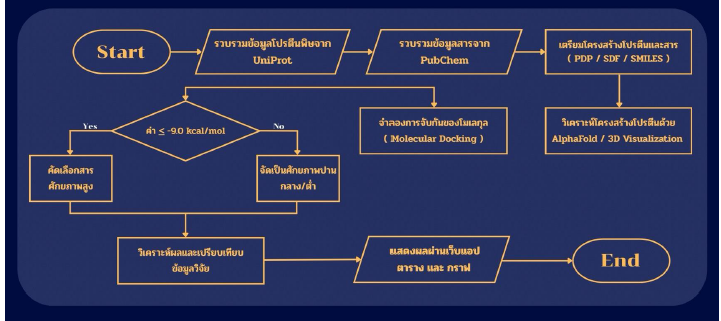
โครงงานการวิเคราะห์โครงสร้างโปรตีนในพิษแมงกะพรุนกล่อง โดยใช้ฐานข้อมูลชีวสารสนเทศ เพื่อการออกแบบ ยาต้านพิษในอนาคต มีวัตถุประสงค์เพื่อศึกษาโครงสร้างโปรตีนพิษของแมงกะพรุนกล่องและแมงกะพรุนสายพันธุ์ต่าง ๆ รวมถึงหน้าที่และกลไกการออกฤทธิ์ของพิษในระดับโมเลกุลอย่างเป็นระบบ ค้นหาและคัดเลือกสารจากธรรมชาติรวมถึงสารสังเคราะห์ที่มีศักยภาพในการยับยั้งพิษของแมงกะพรุนกล่องโดยใช้การจำลองระดับโมเลกุล (Molecular Docking) และประเมินประสิทธิภาพการจับกันระหว่างสารยากับโปรตีนพิษจากค่า Binding Affinity โครงงานดำเนินการโดยการบูรณาการความรู้ ทางชีววิทยาระดับโมเลกุลเข้ากับเทคโนโลยีชีวสารสนเทศและการพัฒนาเว็บแอปพลิเคชัน ซึ่งเริ่มจากการรวบรวมข้อมูล โปรตีนพิษของแมงกะพรุนกล่องจากฐานข้อมูล UniProt และข้อมูลสารยับยั้งจากฐานข้อมูล PubChem จากนั้นนำข้อมูล มาวิเคราะห์และจำลองการจับกันระหว่างโปรตีนพิษและสารยับยั้ง พร้อมทั้งแสดงผลโครงสร้างโมเลกุลแบบสามมิติและ ผลการวิเคราะห์ในรูปแบบตารางและกราฟผ่านเว็บแอปพลิเคชันที่พัฒนาด้วย React จากการศึกษาพบว่าสารจากธรรมชาติรวมถึงสารสังเคราะห์ที่มีศักยภาพหลายชนิดสามารถจับกับโปรตีนพิษของแมงกะพรุนกล่องได้อย่างมีประสิทธิภาพ โดย สาร Silymarin แสดงค่าการจับสูงที่สุดอย่างสม่ำเสมอในโปรตีนพิษทุกชนิด ขณะที่โปรตีนพิษ CFTX-1 และ CFTX-2 แสดงความไวต่อการยับยั้งมากกว่าเมื่อเปรียบเทียบกับ CFTX-A และ CFTX-B การศึกษานี้จะเป็นประโยชน์ต่อการ ศึกษาพิษวิทยาในระดับโมเลกุล ช่วยลดข้อจำกัดด้านเวลา ด้านค่าใช้จ่ายของการทดลองในห้องปฏิบัติการ เป็นพื้นฐานสำคัญสำหรับการวิจัยและพัฒนายาต้านพิษแมงกะพรุนในอนาคต
The project Analysing the protein structure of Chironex fleckeri venom using bioinformatics databases for the future anti-venom design aims to systematically study the venom protein structure of Chironex Fleckeri and other jellyfish species, including their function and mechanism of action at the molecular level. It also seeks to identify and select natural and synthetic compounds with the potential to inhibit Chironex Fleckeri venom using molecular docking simulations and evaluate the binding efficiency between the compounds and venom proteins based on binding affinity values. The project integrates molecular biology knowledge with bioinformatics technology and web application development. It begins by collecting Chironex Fleckeri venom protein data from the UniProt database and inhibitor data from the PubChem database. This data is then analyzed and binding between venom proteins and inhibitors is simulated, displaying three-dimensional molecular structures and analysis results in tabular and graph formats via a web application developed using Streamlit. The study found that several potential natural and synthetic compounds can efficiently bind to Chironex Fleckeri venom proteins, with Silymarin consistently showing the highest binding affinity among all venom proteins. While the toxic proteins CFTX-1 and CFTX-2 showed greater sensitivity to inhibition compared to CFTX-A and CFTX-B, this study will be beneficial for molecular toxicology studies, overcoming the time and cost constraints of laboratory experiments and providing a crucial foundation for future research and development of anti-jellyfish venom.