การพัฒนาอุปกรณ์ผลิตกระแสไฟฟ้าจากการสังเคราะห์ด้วยแสงของสาหร่ายสีเขียวChlorella vulgaris สาหรับอุปกรณ์ IoT (Internet of Things) เพื่อสิ่งแวดล้อมที่ยั่งยืน
Development of an electricity-generating device using photosynthesis of green algae Chlorella vulgaris for IoT applications toward environmental sustainability
Keywords:
Microalgae, Bioelectricity, Electron Transfer, IoT Devices , Bio-photovoltaic CellAbstract
ในอนาคต แหล่งพลังงานที่เป็นมิตรต่อสิ่งแวดล้อมมีความจำเป็นอย่างเร่งด่วนต่อความยั่งยืนของโลก งานวิจัยนี้จึงศึกษาแหล่งพลังงานทางเลือกสำหรับเทคโนโลยีอินเทอร์เน็ตในทุกสรรพสิ่ง (Internet of Things: IoT) ซึ่งมีบทบาทสำคัญในการเพิ่มประสิทธิภาพการควบคุมและจัดการพลังงาน สาหร่ายสีเขียว Chlorella vulgaris มีความสามารถในการปลดปล่อยอิเล็กตรอนและถ่ายโอนผ่านอิเล็กโทรดในกระบวนการสังเคราะห์ด้วยแสง อีกทั้งยังพบได้ง่ายและมีความทนทานต่อสภาพแวดล้อมที่หลากหลาย คณะผู้วิจัยจึงพัฒนาเซลล์ไฟฟ้าชีวภาพโดยใช้สาหร่ายดังกล่าว ซึ่งประกอบด้วยเส้นใยเหล็กกล้าเคลือบสาหร่ายในสารละลาย Alginate และแท่งแกรไฟต์ทำหน้าที่เป็นขั้วอิเล็กโทรดภายในแชมเบอร์เดียวกัน จากการทดลอง ได้ดำเนินการเปรียบเทียบประสิทธิภาพการผลิตกระแสไฟฟ้าระหว่างการเลี้ยงใน TAP medium และการตรึงเซลล์ด้วย Sodium Alginate ภายใต้สภาวะแสงที่แตกต่างกัน ผลการศึกษาพบว่า ระบบสามารถให้ค่ากระแสไฟฟ้าสูงสุดเท่ากับ 42.37 ไมโครแอมแปร์ ภายใต้ความต้านทาน 10 กิโลโอห์ม โดยการตรึงเซลล์ด้วย Sodium Alginate ส่งผลให้ค่ากระแสไฟฟ้าสูงกว่าการเลี้ยงใน TAP medium อย่างมีนัยสำคัญตลอดช่วงการทดลอง ทั้งในด้านค่ากระแสเฉลี่ยที่สูงกว่าประมาณ 2–2.5 เท่า เสถียรภาพของกระแสไฟฟ้าที่ดีกว่า และความสามารถในการฟื้นตัวของกระแสไฟฟ้าได้อย่างรวดเร็วภายหลังช่วงงดแสง ผลการศึกษานี้ชี้ให้เห็นว่าการตรึงเซลล์เป็นปัจจัยสำคัญที่ช่วยเสริมประสิทธิภาพการถ่ายโอนอิเล็กตรอนและยกระดับสมรรถนะการผลิตกระแสไฟฟ้าในเซลล์ไฟฟ้าชีวภาพอย่างมีนัยสำคัญ อีกทั้งยังสะท้อนถึงศักยภาพของ Chlorella vulgaris ในการพัฒนาเป็นแหล่งพลังงานทางเลือกสำหรับอุปกรณ์ IoT และระบบพลังงานที่มุ่งสู่ความยั่งยืนในอนาคต
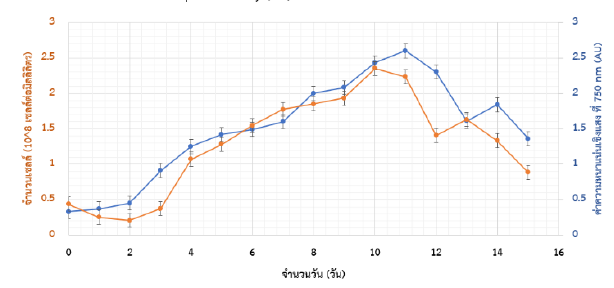
This article presents the urgent need for environmentally friendly energy sources to ensure global sustainability in the future. Therefore, this research investigates an alternative energy source for Internet of Things (IoT) technology, which enhances the efficiency of energy control and management and plays a significant role in promoting sustainability in both energy and environmental aspects. The green microalgae Chlorella vulgaris has the ability to release excess electrons outside the cell and transfer them through electrodes during the photosystem process. Moreover, it is easily obtainable and highly tolerant to diverse environmental conditions. Consequently, a bioelectricity generation system based on Chlorella vulgaris was developed, and various factors affecting electrical energy production were investigated. The developed bio-photovoltaic cell consisted of steel fibers coated with green algae embedded in an alginate solution, with graphite rods serving as electrodes within a single chamber. Experimental results showed that the system generated a maximum voltage of 0.447 V and a maximum current of 42.37 µA, with a 10 kΩ resistor integrated into the circuit. In addition, the study of Chlorella vulgaris characteristics revealed that cell density increased continuously, reaching a maximum of 2.35 × 10⁸ cells/mL on day 10 before declining thereafter. Meanwhile, the optical density measured at a wavelength of 750 nm for algae diluted tenfold, using distilled water as a blank, reached a maximum value of 2.6 absorbance units (AU) on day 11 before decreasing. Ultimately, the evaluation of the electrical generation efficiency of Chlorella vulgaris demonstrates the potential of green microalgae as a sustainable energy source in bio-photovoltaic cell cells for future energy applications.