ประสิทธิภาพการสังเคราะห์ด้วยแสง เศษซากชีวมวล และพลวัตของรากฝอย ภายใต้การจากัดปริมาณนาฝนลดลง ร้อยละ 50 ในป่าเต็งรังทุติยภูมิ
Photosynthetic efficiency, litterfall production, and fine root dynamics under a 50% rainfall reduction in secondary dry dipterocarp forests
Keywords:
ป่าเต็งรังทุติยภูมิ, เศษซากชีวมวล, Secondary dry dipterocarp forest, Litterfall productionAbstract
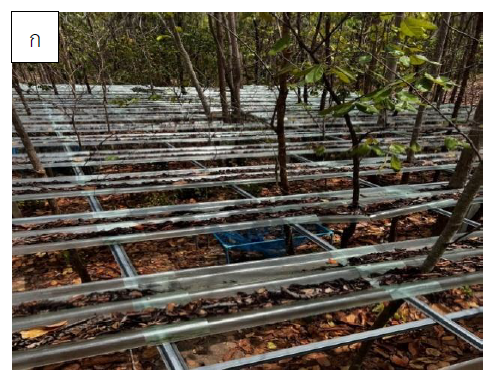
การเปลี่ยนแปลงสภาพภูมิอากาศส่งผลกระทบอย่างมีนัยสาคัญต่อระบบนิเวศป่าไม้ โดยเฉพาะในป่าเขตร้อนที่มีความผันแปรของภูมิอากาศสูง โดยเฉพาะป่าเต็งรัง ซึ่งเป็นป่าที่มีการปรับตัวต่อสภาพอากาศที่แห้งแล้ง เนื่องจากมีความแปรปรวนต่อภาวะฝนทิ้งช่วงที่รุนแรง การศึกษานี้มีวัตถุประสงค์เพื่อศึกษาอิทธิพลจากการลดปริมาณน้าฝนลง ร้อยละ 50 ต่อประสิทธิภาพการสังเคราะห์ด้วยแสง เศษซากชีวมวล และพลวัตของรากฝอยในป่าเต็งรังทุติยภูมิ ในพื้นที่ป่าเต็งรังทุติยภูมิในมหาวิทยาลัยเทคโนโลยีพระจอมเกล้าธนบุรี วิทยาเขตราชบุรี ระหว่างเดือนมีนาคม 2567 ถึงกุมภาพันธ์ 2568 โดยคัดเลือกไม้เด่น 5 ชนิดพันธุ์ โดยวิเคราะห์ประสิทธิภาพการสังเคราะห์ด้วยแสงด้วยค่า Fv/Fm และดัชนีประสิทธิภาพการสังเคราะห์ด้วยแสง (Pi) การศึกษาพบว่าในฤดูแล้ง ค่า Fv/Fm ลดลงอย่างมีนัยสาคัญของต้นไม้ทุกชนิด นอกจากนี้ ผลผลิตเศษซากชีวมวลภายใต้สภาวะน้าฝนลดลง ส่งผลต่อปริมาณผลผลิตเศษซากชีวมวลอย่างมีนัยสาคัญ ขณะที่พลวัตของรากฝอยมีการเพิ่มขึ้นอย่างมีนัยสาคัญต่อสภาวะแล้ง สะท้อนให้เห็นถึงกลไกการปรับตัวของพืชต่อภัยแล้ง แม้มีภาวะขาดแคลนน้า ผลการศึกษาแสดงให้เห็นว่า การลดลงของปริมาณน้าฝนส่งผลกระทบอย่างมีนัยสาคัญต่อประสิทธิภาพการสังเคราะห์ด้วยแสง เศษซากชีวมวลและพลวัตของรากฝอย ที่สอดคล้องกับวัฎจักรคาร์บอนในระบบนิเวศป่าไม้ ชี้ให้เห็นถึงผลกระทบของพันธุ์ไม้ต่อศักยภาพในการปรับตัวของระบบนิเวศป่าไม้ภายใต้สภาวะโลกร้อนในอนาคต
Climate change has significantly affected forest ecosystems, particularly tropical forests characterized by high climatic variability. Dry dipterocarp forests, which are adapted to dry conditions, are especially sensitive to prolonged drought and irregular rainfall patterns. This study aimed to investigate the effects of a 50% reduction in rainfall on photosynthetic efficiency, litterfall production, and fine root dynamics in a secondary deciduous dipterocarp forest. The study was conducted at King Mongkut’s University of Technology Thonburi, Ratchaburi campus from March 2024 to February 2025. Five dominant tree species were selected for observation. Photosynthetic performance was evaluated using the maximum quantum efficiency of photosystem II (Fv/Fm) and the Performance Index (PI). The results showed that during the dry season, Fv/Fm values significantly decreased in all studied species. In addition, reduced rainfall significantly affected litter biomass production. In contrast, fine root dynamics showed a significant increase under drought conditions, reflecting plant adaptive mechanisms to water limitation. Overall, the findings indicate that reduced rainfall significantly influences photosynthetic efficiency, litterfall production, and fine root dynamics, which are closely linked to carbon cycling in forest ecosystems. These results highlight species-specific responses and the adaptive potential of forest ecosystems under future climate change scenarios.