คาร์บอนฟุตพริ้นท์ของการผลิตยาเม็ด
Carbon footprint for tablets drug production
Keywords:
Carbon Footprint, Pharmaceutical Industry, Life Cycle Assessment (LCA), Tablets, BCG EconomyAbstract
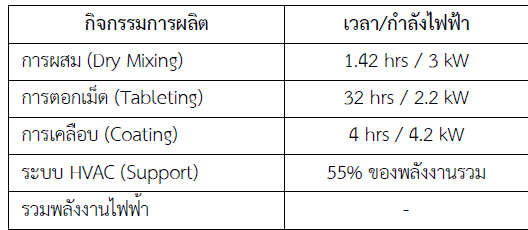
วิกฤตการณ์การเปลี่ยนแปลงสภาพภูมิอากาศส่งผลให้อุตสาหกรรมยาทั่วโลกเผชิญแรงกดดันในการลดการปล่อยก๊าซเรือนกระจก ซึ่งภาคสาธารณสุขมีสัดส่วนการปล่อยก๊าซเรือนกระจกสูง โดยอุตสาหกรรมยามีความเข้มข้นของคาร์บอนสูงกว่าอุตสาหกรรมยานยนต์ การศึกษานี้มีวัตถุประสงค์เพื่อประเมินคาร์บอนฟุตพริ้นท์ของผลิตภัณฑ์ (Carbon Footprint Product: CFP) กรณีศึกษายาเม็ดเคลือบฟิล์ม HYDRA 50 FC (Lot No. 0124TH34) ขนาดบรรจุ 1,000,000 เม็ดต่อรุ่นการผลิต โดยใช้หลักการประเมินวัฏจักรชีวิต (Life Cycle Assessment: LCA) ตามมาตรฐาน ISO 14067 และแนวทางขององค์การบริหารจัดการก๊าซเรือนกระจก (TGO) ในขอบเขตแบบ Gate-to-Gate โดยมุ่งเน้นการเก็บข้อมูลปฐมภูมิจากบันทึกการผลิตจริง (Batch Processing Record) ครอบคลุมขั้นตอนการผสมแห้ง การตอกเม็ดยา และการเคลือบผิว ผลการวิเคราะห์เชิงวิศวกรรมพบว่า "จุดวิกฤต" (Hotspots) ของการปล่อยก๊าซเรือนกระจกมาจาก 2 ส่วนหลัก ได้แก่ 1) พลังงานไฟฟ้าในระบบควบคุมสภาวะแวดล้อม (HVAC) สำหรับห้องสะอาด Grade C/D ซึ่งคิดเป็นสัดส่วนร้อยละ 40-60 ของการใช้ไฟฟ้าทั้งหมด และ 2) วัตถุดิบประเภทตัวยาสำคัญ (API) Hydralazine HCl ซึ่งมีค่าศักยภาพในการทำให้เกิดภาวะโลกร้อน (GWP) สูงกว่าสารเคมีทั่วไปถึง 25 เท่า นอกจากนี้ ข้อมูลจากการศึกษาชี้ให้เห็นว่าการเปลี่ยนผ่านสู่เทคโนโลยีการผลิตแบบต่อเนื่อง (Continuous Direct Compression: CDC) มีศักยภาพในการลดการใช้พลังงานได้ถึงร้อยละ 69 เมื่อเทียบกับระบบแบทช์ดั้งเดิม ผลจากการศึกษานี้ไม่เพียงแต่ช่วยระบุปริมาณคาร์บอนเทียบเท่าต่อหน่วยผลิตภัณฑ์ แต่ยังเป็นรากฐานสำคัญในการกำหนดเป้าหมายการปล่อยก๊าซเรือนกระจกสุทธิเป็นศูนย์ (Net Zero) และยกระดับขีดความสามารถในการแข่งขันของอุตสาหกรรมยาไทยภายใต้โมเดลเศรษฐกิจ BCG
The climate change crisis has intensified global pressure on the pharmaceutical industry to mitigate greenhouse gas (GHG) emissions. Globally, the healthcare sector accounts for 4.4% of total net emissions, with pharmaceutical manufacturing exhibiting a carbon intensity 55% higher than that of the automotive industry. This study aims to evaluate the Product Carbon Footprint (PCF) of a film-coated tablet, HYDRA 50 FC (Lot No. 0124TH34), with a production scale of 1,000,000 tablets per batch. The assessment utilizes the Life Cycle Assessment (LCA) methodology in accordance with ISO 14067 and the Thailand Greenhouse Gas Management Organization (TGO) guidelines, following a "Gate-to-Gate" system boundary. The research involves collecting primary activity data from actual Batch Processing Records (BPR), encompassing dry mixing, tableting, and film coating processes. Engineering analysis identifies primary "Hotspots" of GHG emissions: 1) electrical energy consumption from HVAC systems in Grade C/D cleanrooms, contributing 40-60% of total plant energy, and 2) the active pharmaceutical ingredient (API), Hydralazine HCl, which possesses a Global Warming Potential (GWP) up to 25 times higher than basic chemicals. Furthermore, the study indicates that transitioning to Continuous Direct Compression (CDC) technology offers a 69% reduction in energy consumption compared to traditional batch manufacturing. The findings of this study not only quantify the CO2 equivalent per functional unit but also provide a critical foundation for establishing Net Zero targets and enhancing the competitiveness of the Thai pharmaceutical industry under the Bio-Circular-Green (BCG) economic model.