การประเมินฤทธิ์ต้านอนุมูลอิสระของสารสกัดจากพืชวงศ์มะม่วง
Evaluation of antioxidant activity of Anacardiaceae plant extracts
Keywords:
Anacardiaceae, DPPH, ABTS, พืชวงศ์มะม่วง, อนุมูลอิสระAbstract
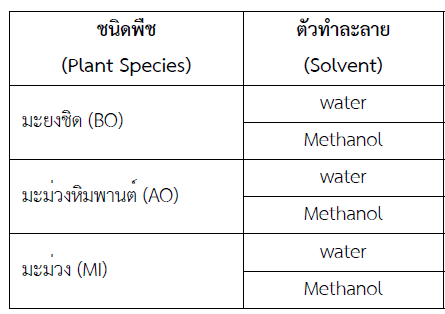
โดยปกติแล้วใบพืชแห้งภายในพื้นที่เกษตรกรรมมักถูกทิ้งให้เป็นขยะชีวมวลหรือนำไปใช้เพื่อการผลิตปุ๋ยหมักเท่านั้น ซึ่งถือเป็นการใช้ประโยชน์ที่ยังไม่เต็มประสิทธิภาพ งานวิจัยนี้จึงมีวัตถุประสงค์เพื่อเพิ่มมูลค่าให้แก่เศษวัสดุเหลือทิ้งดังกล่าวเพื่อประเมินศักยภาพในการนำไปพัฒนาเป็นผลิตภัณฑ์ที่มีมูลค่าสูงขึ้นในอนาคต การศึกษานี้มีวัตถุประสงค์เพื่อเปรียบเทียบฤทธิ์การต้านอนุมูลอิสระของสารสกัดใบพืช 3 ชนิด ได้แก่ มะยงชิด (Bouea oppositifolia (Roxb.) Meisn.), มะม่วงหิมพานต์ (Anacardium occidentale L.) และมะม่วง (Mangifera indica) โดยใช้ตัวทำละลายน้ำและเมทานอล สกัดที่อุณหภูมิ 60 องศาเซลเซียส เป็นเวลา 1 ชั่วโมง ทดสอบฤทธิ์ด้วยวิธี DPPH และ ABTS radical scavenging assays
ผลการทดลองพบว่า ตัวทำละลายเมทานอลมีประสิทธิภาพในการสกัดสารออกฤทธิ์สูงกว่าน้ำอย่างมีนัยสำคัญในพืชทุกชนิด ในการทดสอบวิธี DPPH สารสกัดเมทานอลของใบมะยงชิดมีฤทธิ์สูงสุด โดยมีค่า IC50 เท่ากับ 0.0160 μg/ml ขณะที่สารสกัดน้ำของใบมะม่วงหิมพานต์โดดเด่นที่สุดในกลุ่มสกัดน้ำมีค่าการยับยั้ง 81.88% สำหรับการทดสอบวิธี ABTS พบว่าสารสกัดเมทานอลและน้ำจากใบมะม่วงหิมพานต์ มีค่า IC50 ต่ำที่สุด (0.0145 และ 0.0269 μg/ml ตามลำดับ) แสดงให้เห็นว่าใบมะม่วงหิมพานต์มีสารสำคัญที่ละลายน้ำได้ดี และมีประสิทธิภาพสูงใกล้เคียงกับเมทานอล สรุปได้ว่าใบพืชทั้ง 3 ชนิด โดยเฉพาะใบมะม่วงหิมพานต์ มีศักยภาพสูงในการพัฒนาเป็นสารต้านอนุมูลอิสระจากธรรมชาติสำหรับอุตสาหกรรมสุขภาพต่อไป
Dry agricultural leaves are typically discarded as biomass or underutilized as compost. This study aims to enhance the value of such waste by evaluating the antioxidant potential of plants in the Anacardiaceae family for future high-value product development. Coarsely ground dry leaves of Marian Plum, Mango, and Cashew Nut were extracted using DI water and methanol (1:20 ratio) at 60°C for 60 minutes. The antioxidant activities were analyzed using DPPH and ABTS assays.
Results showed that all dry leaf extracts possessed significant antioxidant properties, varying by species and solvent. In the DPPH assay, the water extract of Mango was the most effective (IC50 = 0.7379). Conversely, the ABTS assay revealed that the water extract of Cashew Nut exhibited the highest potency (IC50 = 0.5223). Most extracts demonstrated dose-dependent activity, with maximum inhibition ranging from 73.48% to 96.28% at a 50% concentration. These findings confirm that dry leaves from the Anacardiaceae family are a promising source of natural antioxidants, providing a viable pathway for increasing the economic value of agricultural waste.