Feasibility of the 9Rs Circular Economy Framework for Household Waste Management in High-Rise Residential Buildings in Bangkok
Keywords:
9Rs-circular economy, Household waste, Waste management, High-rise residential buildingsAbstract
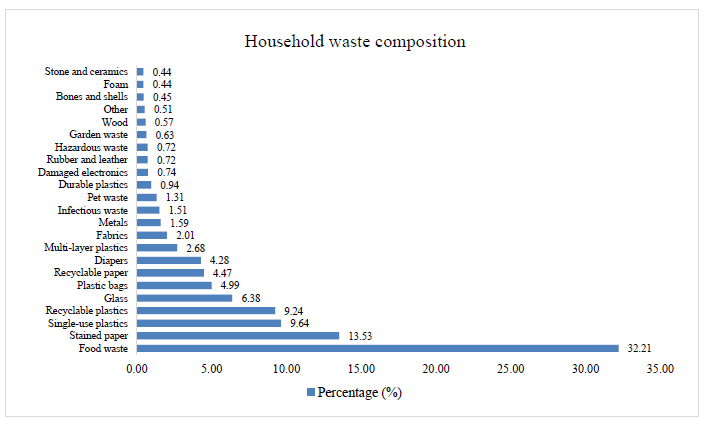
Rapid urbanization has intensified household waste management challenges within high-rise residential buildings. The application of advanced circular economy frameworks at the building unit-level remains limited. This study investigated the feasibility of applying the 9Rs circular economy framework to household waste management in high-rise residential buildings in Bangkok, with a focus on buildings operating at approximately 300 residential units. Waste generation and composition profiles were collected from residential buildings in the Watthana and Khlong Toei districts using the WACS guideline. The results indicated a mean waste generation rate of 0.91 ± 0.19 kg/unit/day, with a moderate CV reflecting inter-building variability attributable to differences in occupancy behavior and household consumption patterns. Characterization analysis showed that general waste constitutes the largest proportion, followed by organic, recyclable, and hazardous waste at 40.8%, 33.6%, 22.8%, and 2.8%, respectively. At a detailed subcategory level was classified into 23 subcategories spanning composition was dominated by food waste, stained paper, single-use plastics, and recyclable plastics at 32.21%, 13.53%, 9.64%, and 9.24%, respectively. Which collectively constituting approximately 65% of total waste generated. Systematic mapping of the 23 waste subcategories against the 9Rs framework demonstrated that more than 90% of identified fractions possess at least one viable circular economy pathway. However, the aggregate flow is heavily skewed toward low-order recovery strategies, particularly R9 (Recover) due to high organic moisture and material contamination, followed by R7 (Repurpose), R3 (Reuse) and R8 (Recycle), reflected the structural limitations imposed by insufficient source separation and indicated that while waste generation rates are relatively uniform, individual consumption behaviors and lifestyle patterns vary significantly. The study concluded that transitioning to a circular economy building-scale is partially and conditionally feasible due to mixture of household waste. The findings provide the design of building-scale circular waste management strategies with source separation infrastructure for maximizing the recovery of high-potential resources into recovery process.