Toward a Dual-Constraint Perspective in Real Estate Feasibility Assessment at the Early Design Stage
Keywords:
BIM-LCA-LCC, Dual-Constraint Feasibility Framework, Low-Carbon Development, Decision Support, Sustainable Real Estate DevelopmentAbstract
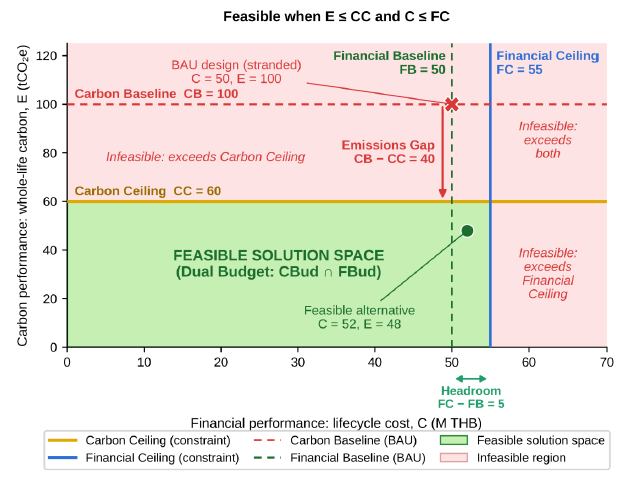
The building and construction sector is a major contributor to global greenhouse gas emissions through both embodied and operational carbon generated throughout the building lifecycle. As climate-related regulations, sustainability commitments, and investor expectations continue to evolve, real estate development is increasingly required to balance environmental responsibility with financial viability. However, early-stage development decisions remain predominantly driven by conventional financial feasibility assessments, while carbon considerations are frequently evaluated as separate performance metrics rather than integral components of project feasibility. This separation contributes to carbon lock-in, limits opportunities for proactive carbon reduction, and increases exposure to climate-related transition risks. Addressing this challenge, this study proposes a conceptual Dual-Constraint Feasibility Framework (DCFF) that positions carbon and financial considerations as interconnected dimensions of project feasibility during the early design stage. The framework introduces Carbon Baseline and Carbon Ceiling alongside Financial Baseline and Financial Ceiling as project-level boundaries that collectively define the feasible solution space for development alternatives. The Carbon Ceiling is operationalized as the maximum allowable whole-life carbon of a project, covering both embodied and operational carbon, expressed in tCO₂e over a 50-year reference study period, and derived, once an ambition level has been determined at the policy or national level, either from a downscaled carbon budget or from a required reduction below the Carbon Baseline. Building Information Modeling (BIM), Life Cycle Assessment (LCA), and Life Cycle Costing (LCC) are conceptualized as complementary enabling tools that support the generation, assessment, and comparison of alternative development scenarios. The proposed Dual Budget concept enables design alternatives to be evaluated according to their ability to operate within both carbon and financial boundaries simultaneously, so that feasibility is reframed as the capacity of development alternatives to satisfy interconnected environmental and economic requirements rather than optimizing a single objective in isolation. The study contributes to advancing feasibility assessment from a predominantly financial perspective toward a more integrated and systems-oriented approach aligned with low-carbon development, sustainable cities, and climate-resilient infrastructure, and provides a conceptual foundation for future decision-support tools capable of supporting transparent, traceable, and climate-aligned development decisions.