Comparative Assessment of Estimated Cellular Carbon and Growth Performance of Live-Feed Microalgae Used in Aquaculture
Keywords:
Biomass productivity, Carbon capture capacity, CO2 fixation, Live feed culture, Marine microalgaeAbstract
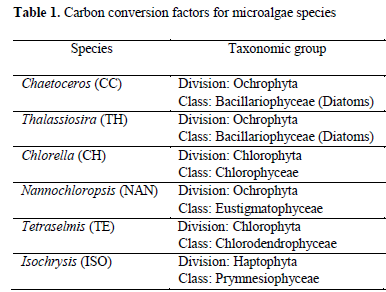
Microalgae have gained increasing attention as a sustainable solution for carbon capture due to their high photosynthetic efficiency and rapid biomass production. In aquaculture systems, microalgae are widely used as live feeds; however, their carbon sequestration potential (CSP) has not been systematically evaluated. This study aimed to assess the CSP of six microalgal species (Chaetoceros, Thalassiosira, Chlorella, Nannochloropsis, Tetraselmis, and Isochrysis) based on growth performance and biomass production, and to analyze the relationships among growth rate, cell density, and CSP. Microalgae were cultivated under controlled laboratory conditions (25±1°C, 28 psu, 12L:12D photoperiod, ~3,000 Lux) for 15 days, and key growth parameters, including growth rate, maximum cell density, and biomass production, were determined. CSP was estimated indirectly using cell density and literature-derived carbon conversion factors, and relationships among variables were analyzed using Pearson’s correlation. Growth rate showed no significant direct relationship with estimated carbon content across all species (P>0.05). Biomass production, estimated from changes in cell density, showed strong positive correlations with estimated carbon content (r = 0.64-0.98, P<0.05-0.01), indicating its relevance to comparative carbon accumulation potential CSP. Because carbon was estimated from cell density and literature-derived carbon conversion factors rather than directly quantified, the results should be interpreted as comparative estimates. These findings provide a comparative framework for evaluating carbon accumulation potential among live feed microalgae and support their potential integration into sustainable, low-carbon aquaculture systems.