Climate Risk Projection and Economic Vulnerability Assessment of Outdoor Mass Culture of S-Type Rotifer Under Warming Scenarios
Keywords:
Adaptive aquaculture production strategy, Climate resilience, Live feed cultureAbstract
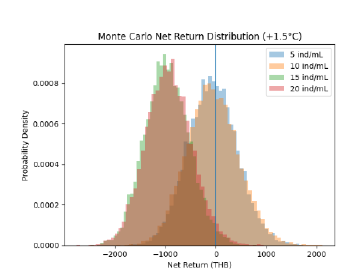
S-type rotifer (Brachionus rotundiformis) is an essential live feed in marine aquaculture. Rising globlal temperature may impair its growth and production capacity. This study established a quantitative climate risk framework to evaiuate the economic vulnerability and resilience of outdoor rotifer production under warming scenarios. A climate-adjusted production model was developed to simulate economic performance under projected temperature increases of +1.5oC, +2oC, and +4oC, with the objective of identifying economically optimal and climate-resilient stocking densities for rotifer cultivation. Under baseline thermal conditions (26.39-27.07oC), a stocking density of 10 ind./mL yielded the highest net return (430.19 THB per 1,000 L), followed by 5 ind./mL (397.31 THB per 1,000 L). In contrast, higher densities (15-20 ind./mL) exhibited signs of overstocking, characterized by reduced productivity, elevated production costs, and negative economic returns. However, under warning scenarios, all production systems shifted toward economic losses beginning at +1.5oC . High-density systems (15-20 ind./mL) exhibited the greatest vulnerability, with probability of loss exceeding 95% and strongly negative economic resilience ratio (ERR) values. At +4oC, economic risk intensified across all densities, as net return distributions shifted substantially towars negative values and value at risk (VaR5%) indicated amplified downside risk. Monte Carlo simulations further demonstrated that loss probability increased progressively with temperature, approaching certainty (````````````````````````````approximately 100%) at +4oC. Overall, rising temperature reduced both biological productivity and economic stability. Stocking densities of 5-10 ind./mL demonstrated comparatively greater resilience than higher-density systems, underscoring the importance of climate-informed density optimization to sustain live feed production under warming conditions.