Microplastic Contamination in Deep Confined Aquifers of the Lower Chao Phraya Basin: Implications for Groundwater Resilience
Keywords:
microplastics, groundwater, confined aquifer, Lower Chao Phraya Basin, resilienceAbstract
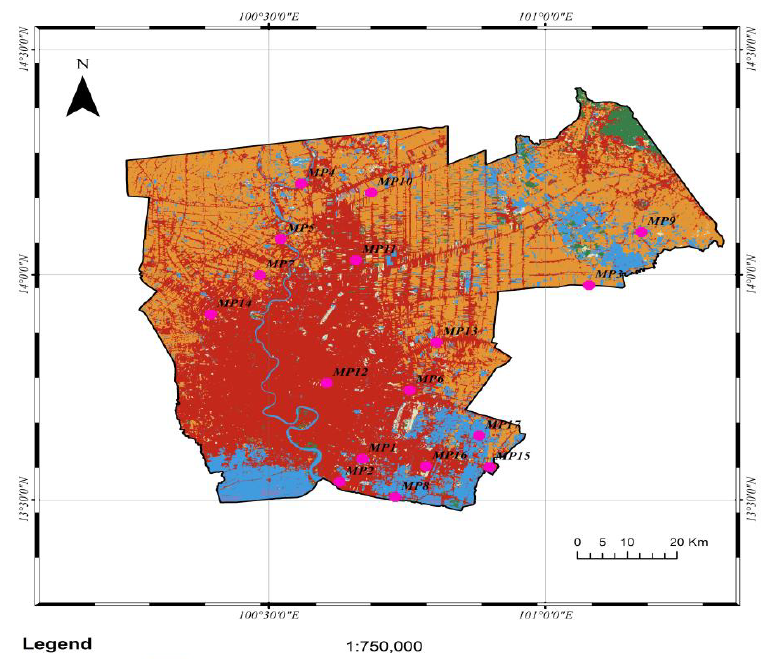
Confined aquifers are conventionally regarded as protected from surface-derived contaminants by low-permeability aquitards, yet the extent to which this protection holds for emerging contaminants such as microplastics (MPs) remains poorly tested. This study investigates MP occurrence and physical characteristics in seventeen wells tapping the Nakhon Luang and Nonthaburi confined aquifers of the Lower Chao Phraya Basin, Thailand, as part of a 2025/26 field campaign. Each 5 L groundwater sample was filtered, digested in 30% hydrogen peroxide, and separated by density in saturated sodium chloride solution, then counted and characterized under a stereomicroscope with hot-needle confirmation. Microplastics were detected in all seventeen wells, with concentrations ranging from 0.40 to 7.00 particles per litre (mean 2.25 ± 2.20, median 1.00). Of the 191 confirmed particles, fragments accounted for 54.5% and fibres 45.5%; no films were recorded. Green, white, and blue were the dominant colours, together accounting for 71.5% of characterized particles. Fourier-transform infrared spectroscopy on a representative subsample identified polyethylene and polypropylene as present polymer types. Despite the protective role of the confining Bangkok Clay, contamination was detected throughout the sampled wells, suggesting that borehole construction and well-casing integrity, rather than aquifer confinement alone, govern microplastic vulnerability in this system. These findings indicate that structural protection from surface contamination is partial rather than absolute, with implications for the long-term resilience of confined groundwater resources under increasing anthropogenic and climatic pressure. This baseline dataset provides a foundation for future spatial and predictive modelling of contamination drivers across the basin's confined aquifer system.