Can Emotional Reciprocity with AI Companions Support Healthy Habit Formation? A Conceptual Framework and Trial Protocol
Keywords:
AI companions, Emotional reciprocity, Healthy habit formation, Digital health, Behavioural autonomyAbstract
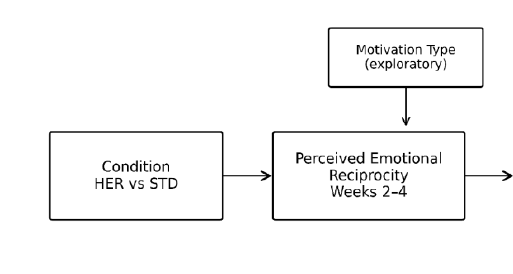
Preventive health outcomes depend not only on initiating beneficial behaviours but on sustaining them long enough for repeated actions to become increasingly automatic. Digital health tools can extend behavioural support beyond conventional healthcare settings, yet engagement often declines after initial adoption. This paper proposes perceived emotional reciprocity as a mechanism through which relationally designed AI companions may support healthy habit formation. Perceived emotional reciprocity refers to the user's felt experience that an AI companion receives, understands, remembers, validates, and responds to personal needs, difficulties, and progress in a contextually relevant way across repeated interactions. The conceptual framework draws on post-adoption technology research, attachment theory, Self-Determination Theory, relational responsiveness, and habit-formation research. A 12-week, two-arm randomized controlled trial is proposed among AI-familiar adults who have identified a non-clinical healthy habit that they have previously attempted but struggled to sustain. Participants will be randomized to a High Emotional Reciprocity (HER) condition or a Standard (STD) supportive AI condition delivered through LINE. Both conditions provide supportive health information through the same platform, while the HER condition adds relational continuity, personalised responsiveness, emotional validation, progress acknowledgement, and longitudinal awareness. The primary model tests a serial pathway from experimental condition to early perceived emotional reciprocity, subsequent engagement consistency, and Week-12 habit automaticity. Recruitment and data collection will begin only after research ethics approval; therefore, this paper presents the conceptual framework and prespecified trial protocol rather than empirical outcomes. The proposed contribution is a shift from evaluating AI-supported health behaviour primarily by engagement volume toward evaluating whether relational AI design helps users maintain the repeated behaviour required for habit automaticity and, ultimately, behavioural autonomy with reduced reliance on external support.