Characteristics of Liquid Products Derived from Lignocellulosic Biomassvia CO₂-Assisted Hydrothermal Treatment
Keywords:
HMF, Hydrothermal reaction, Lignocellulosic biomass, CO₂Abstract
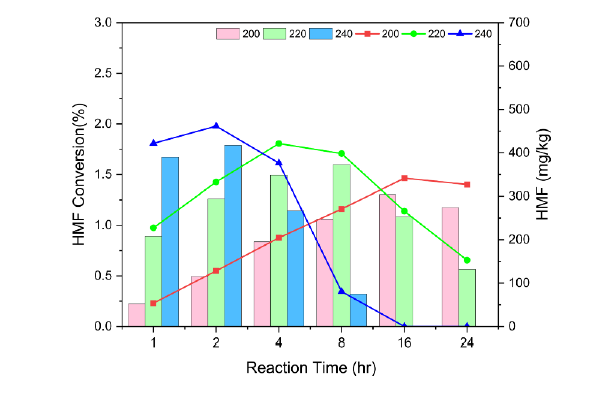
Cellulose contained in Empty Fruit Bunches (EFBs), an underutilized biomass resource, can be used as a promising feedstock for the production of bio-based platform chemicals. In this study, the potential for HMF production from EFB through hydrothermal reaction under CO₂ conditions was evaluated, and the effects of reaction temperature and time on HMF formation were investigated. Hydrothermal reactions were conducted at 180–300 °C for 1 h. To evaluate the effect of reaction time, additional experiments were performed at 200–240 °C with reaction times ranging from 1 to 24 h. The results showed that the highest HMF production was obtained at 240 °C, with an optimal reaction time of 2 h. However, the HMF production under CO₂ conditions was lower than that under N₂ conditions. This was attributed to the mildly acidic environment formed by CO₂, which may have promoted the further degradation of HMF into by-products such as organic acids and humins.