Multi-Scale Land-Use Change and Vegetation Dynamics in a Tropical Peat Swamp: Implications for Nature-Based Conservation at Wang Krachae, Trat Province, Thailand
Keywords:
Land-use, Peat-swamp, ecosystem, remote sensingAbstract
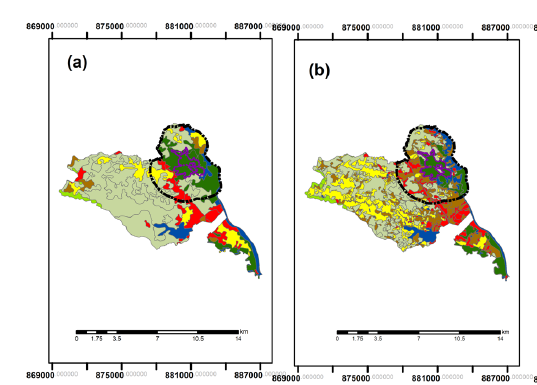
Tropical peat-swamp ecosystems are increasingly threatened by land-use transformation; however, the vegetation cover can persist even after ecological conversion, making greenness alone an unreliable indicator of ecosystem condition. This study assessed long-term land-use change and vegetation dynamics in the Wang Krachae Peat Swamp, Trat Province, eastern Thailand, using a three-scale framework: the peat-swamp interior, a 2 km surrounding buffer, and the wider sub-district, spanning from 2000 to 2024. We analyzed multi-temporal land-use and land-cover data from Thailand's Land Development Department using post-classification comparison and transition matrices, and used dry-season Landsat imagery to derive the Normalized Difference Vegetation Index (NDVI) for six observation years. Wetlands (Peat Swamp Forest) remained dominant within the interior but declined from 95.41% to 88.81%, while the surrounding buffer and sub-district showed far stronger transformation, with wetland cover falling to 21.13% and 10.36%, respectively, alongside substantial plantation and cropland expansion. NDVI declined sharply between 2005 and 2010 across all scales, most severely within the peat-swamp interior (43.7%), coinciding with extensive transitions to Bare/Degraded Land. Vegetation greenness subsequently recovered by 2024, reaching its highest levels across all three scales. However, this recovery occurred alongside continued localized wetland conversion to plantation, indicating that rising NDVI reflects vegetation regrowth rather than restoration of natural wetland structure and function. These findings show that the peat-swamp interior retains substantial natural cover but faces cumulative pressure from surrounding landscape transformation, pointing toward targeted, nature-based conservation strategies scaled to where pressure is greatest, protecting remaining wetland at the interior's margins, prioritizing the buffer zone where conversion risk is most immediate, and addressing cumulative landscape pressure at the sub-district scale.