Simulation-Based Evaluation of a Positive Pressure Ventilation System for Classroom Air Quality Control under Bangkok Haze Conditions: A CONTAM Simulation Study
Keywords:
indoor air quaility, IAQ, PM2.5, CO2, EnergyAbstract
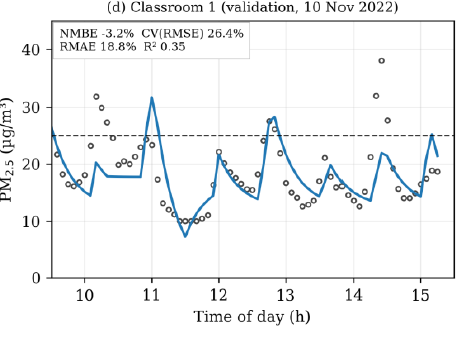
Educational institutions in rapidly urbanizing tropical cities such as Bangkok increasingly face a critical indoor air quality (IAQ) challenge due to seasonal ambient haze episodes—such as the 2025 Bangkok haze event, during which 352 schools were reported closed—in which sealing classrooms to prevent fine particulate matter (PM2.5) infiltration is standard practice. However, this intervention triggers rapid metabolic carbon dioxide (CO₂) accumulation that compromises student health, creating a challenging dual-contaminant crisis that conventional ventilation frameworks fail to solve under strict tropical energy constraints. This study aims to identify positive pressure ventilation configurations for a Bangkok classroom by evaluating trade-offs between indoor air quality and energy consumption. A CONTAM multizone model will be developed and validated against a secondary dataset of previously measured indoor and outdoor PM₂.₅ and CO₂ data. The validated model will then be applied to a scenario matrix combining Normal-Day and Bangkok Haze-Event outdoor conditions, four airflow rates (3, 4, 5, and 6 ACH), and three filter grades (MERV 13, MERV 14, and HEPA H13). IAQ performance will be assessed based on PM₂.₅ reduction, CO₂ control, and the percentage of occupied time within recommended guideline levels for PM₂.₅ (≤25 μg/m³, 24-hour average) and CO₂ (≤1,000 ppm) according to the Thai Ministry of Public Health B.E. 2565 guidelines. In addition, the PM₂.₅ indoor-to-outdoor (I/O) ratio will be used to compare the ability of each PPS configuration to reduce outdoor particle penetration. Energy performance will be evaluated as the total ventilation and cooling energy, comprising PPS fan energy and A/C cooling load for outdoor air conditioning, calculated using a time-step enthalpy method based on Bangkok weather data. The expected outcomes include the identification of ventilation configurations that achieve compliance with Thai national guidelines during haze-event conditions at acceptable energy costs. The results are expected to quantify how higher ACH improves CO₂ dilution but increases cooling demand, while higher-efficiency filters reduce PM₂.₅ exposure but raise fan energy through additional pressure drop. The findings are anticipated to provide practical guidance for climate-resilient classroom ventilation in Bangkok and other Southeast Asian cities affected by seasonal haze.