Projected Shifts in Rainfall-Based Climate Impact Drivers in Thailand
Keywords:
CID, Climate Impact Driver, CMIP6, Rainfall, ThailandAbstract
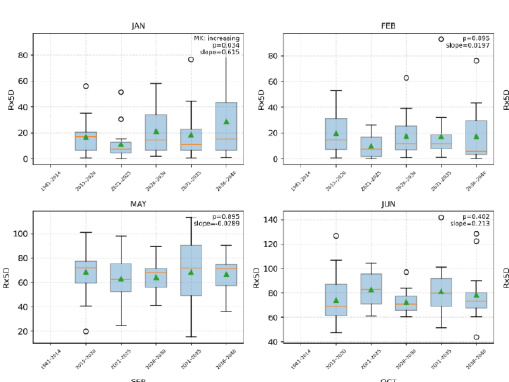
Thailand has experienced increasing impacts from rainfall-related extremes, including recurrent floods and prolonged dry spells, posing serious challenges to water resources, agriculture, and disaster risk management. In 2025, multiple heavy rainfall and flood events were reported across northern, northeastern, and central Thailand, particularly in major river basins, while several regions also faced extended dry conditions during the late dry season, reflecting growing rainfall variability associated with climate change. Climate Impact Drivers (CIDs) provide a useful framework for assessing the mechanisms and impacts of climate-related extremes, and this study focuses on rainfall-based CIDs, including maximum 5-day precipitation (Rx5day), the number of heavy rainfall days exceeding 35 mm (R35mm), and consecutive dry days (CDD), to investigate changes in extreme rainfall and drought characteristics across Thailand. Monthly CID indices were derived from daily grid-based CMIP6 climate data (~0.05° × ~0.05°) using three global climate models (CMCC, EC-Earth3, and MIROC6) under four emission scenarios (SSP1-2.6, SSP2-4.5, SSP3-7.0, and SSP5-8.5), and near-term projections for 2015–2040 were evaluated relative to a historical baseline period of 1981–2014. The results indicate pronounced spatial and seasonal changes in rainfall extremes, with Rx5day and R35mm showing increasing probability and intensity in many regions, suggesting heightened flood risk, particularly in central, eastern, and southern Thailand, whereas CDD exhibits longer and more frequent dry spells in northern and northeastern regions, indicating elevated drought risk. Probability density function analysis reveals a clear shift toward more extreme conditions, accompanied by changes in the seasonal timing of both heavy rainfall and dry periods, highlighting the importance of CID-based assessments for near-term climate risk management and the development of effective adaptation and early warning strategies in Thailand.