Two-Loops of Agricultural Waste Recycling Practice: A Step Towards the Circular Economy
Keywords:
Biochar, Cicular economy, agricultural waste recycling, wastewater treatment, soil enhancementAbstract
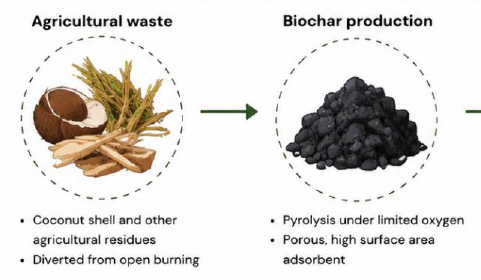
Open burning of agricultural waste is a serious environmental crisis that increases global greenhouse gas emissions, air pollution, and well-being. This research suggests a two-loop biochar-based agricultural waste recycling system based on the concepts of the circular economy for addressing these issues. The study emphasizes using pyrolysis to turn waste coconut shells into biochar, which is then used in two applications, which are agricultural soil enhancement and wastewater. Biochar was filled in the first loop by enriching it with nutrients using NPK solution and heavy metals using Copper (II) sulfate pentahydrate (CuSO₄·5H₂O) to mimic pollutants frequently encountered in wastewater ambient conditions. In order to assess its capacity for nutrient retention, decreased fertilizer consumption, and sustainable farming practices, the enhanced biochar was repurposed as a soil amendment in the second loop. A Completely Randomized Design (CRD) was used for the nutrient leaching tests, and treatments included soil mixed with 0%, 2.5%, 5%, and 10% added biochar. Nitrogen (N), phosphorus (P), potassium (K), and copper (Cu) were measured in leachate samples that were gathered over a duration of four to eight weeks. To assess the impact of enriched biochar on germination percentage and early plant growth in controlled laboratory settings, seed germination tests were also conducted and chemical risk during application. One-way ANOVA was used for statistical testing in order to identify substantial differences between treatments. The viability of a closed-loop system connecting coconut farm leftovers with crop reuse was also assessed using mass balance and material flow analyses, with an emphasis on nutrient recycling and lowering the use of chemical-based fertilizers. Improved nutrient retention, decreased nutrient leaching losses, improved seed germination efficiency, and a lower need on synthetic fertilizers are among the expected results of this study. Overall, this work promotes circular economy principles and environmental sustainability in the future by showcasing the potential benefits of enriched biochar as a multipurpose bio-based material for pollution treatment, recycling nutrients, leaching of heavy metals and sustainable agricultural practices.